

The Pattern
How Prevention Breaks Down - and How It Doesn’t Have To

I have spent my career studying why societies fail to prevent harm they can see coming. I have directed clinical trials involving tens of thousands of participants. I have watched evidence accumulate, be contested, enter guidelines, and then sometimes see these guidelines be implemented unevenly or abandoned. What I have seen, across many fields that share little in substance, is that the failures follow a structure.
Over the last several weeks, I have written about that structure: four gaps that recur whenever a society confronts preventable harm. The recognition gap is where the signals exist, but no one has assembled them into a coherent threat. The evidence gap is where the case is mounting, but the standard of proof keeps rising. The translation gap is where the knowledge exists but has not yet been converted into enforceable obligations. The implementation gap is where the obligations exist, but the follow-through is too weak, too brief, or too easily undermined to deliver the protection that was promised.
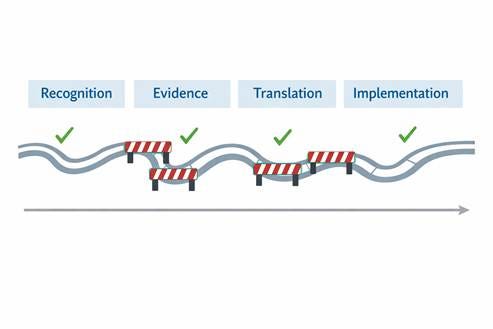
These are not stages that occur in tidy sequence. In practice, they overlap, reinforce each other, and recur. A society can fight the evidence battle and the translation battle simultaneously, as the smartphone case demonstrates right now. A country can pass a law and discover that implementation failures send it back to the drawing board, as has happened repeatedly with climate commitments. This prevention framework is a way of asking, at any given moment, where exactly the breakdown is occurring.
What makes these failures so persistent is that each one seems reasonable. At the recognition stage, the signals really are scattered and ambiguous. At the evidence stage, the science really is incomplete. At the translation stage, the politics really are difficult. At the implementation stage, the resources really are scarce. Every delay has a justification. What history reveals is that the justifications, taken together, form a reliable machinery of inaction and that the cost of that machinery is measured in lives.
In every story I tell in The Preventioneers, someone eventually broke through. Dr. Ignaz Semmelweis could not make the medical establishment accept his evidence, but a generation later, others built the theoretical framework that made his findings impossible to ignore. Benjamin Franklin did not merely warn about fire; he constructed systems that are still protecting people today. They are not the only ones. The book traces physicians who spent thirty years fighting an industry that insisted its product could not be redesigned, a public health official who cut infant mortality in half by building systems her city had never imagined, and a handful of people with no scientific or medical credentials who proved that the simplest interventions could save lives at the moment of greatest crisis. These were not people who waited for consensus. They were people who built it.
The uncomfortable truth at the center of this framework is that prevention rarely succeeds on the merits of the evidence alone. Evidence is necessary, but it is not sufficient. What closes these gaps is a combination of rigorous science, strategic communication, institutional entrepreneurship, political persistence, and moral clarity about who is being harmed and who is benefiting from delay. The prevention pioneers I write about understood this, even when they could not have articulated it in those terms. They did not simply discover that harm was preventable. They did the harder work of making prevention happen against resistance that was sometimes honest and sometimes manufactured, but always formidable.
That is what The Preventioneers is about. Not the science of prevention alone, but the human story of how it succeeds and why it fails. The people in this book span three centuries and half a dozen fields. What they share is the willingness to see a preventable harm clearly and refuse to let the world look away.
The Preventioneers is available May 5.
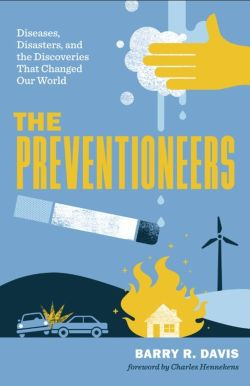
The Preventioneers
Diseases, Disasters, and the Discoveries That Changed Our World
Johns Hopkins University Press | May 5, 2026
In this book, I examine the recurring pattern behind preventable harm — the interval between warning and response — and the individuals who recognized early signals and acted despite resistance.
For those interested, information about The Preventioneers, including preorder options, is available here:
Amazon
https://www.amazon.com/Preventioneers-Diseases-Disasters-Discoveries-Changed/dp/1421454335
Johns Hopkins University Press
https://www.press.jhu.edu/books/title/54000/preventioneers